

Critique Crisis
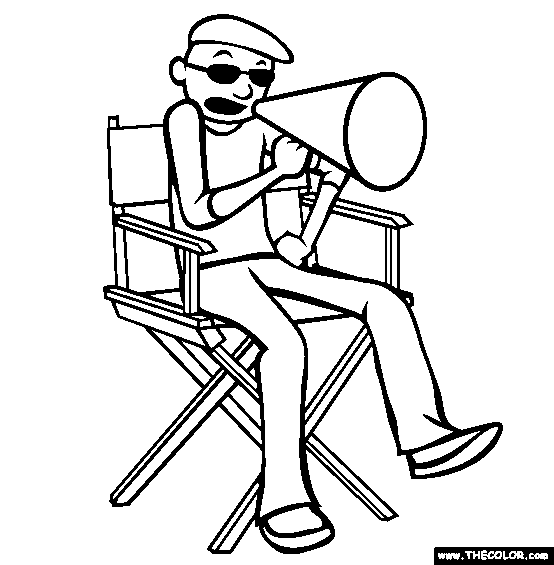
Yep, exactly what it says above. Any of you writers hit one of these? The last couple months, writing and critiquing short stories have filled most of my spare minutes. Sometimes I’m good at it – perhaps over confident. Sometimes, I’m sloppier than I should be.
Two weeks ago, I decided I was going to read Stephen King’s new short story book ‘Just After Sunset’. I wanted to enjoy and read as a reader. So I sat back with my yummy cup of coffee, relaxed, chose a random story, and began to read. Then I stopped. Then reread a sentence. Then stopped. Then reread …just like when I’m critiquing. I kept thinking, no, no, he didn’t write that….which is exactly what he wrote. There were three or four ‘that’s in a row, then a couple adverbs in the next two paragraphs.
My mind kept screaming CUT! Cut! You know, like a movie director or something. The other half of my brain, like The Fonz from Happy Days, kept saying to the director. Chill it, this makes sense. It flows. It unravels. It sounds like the character. We’re cool….I really struggled through the story. The loud mouth director kept screaming at The Fonz. Fonzie kept doin’ his chill thing and my head kept screaming at them both to be quiet.

Finally, they both shut up, and then is when it hit me. It’s the voice King was preserving. His preservation of the voice ranked higher than trying to squeeze as much info out a sentence or scene or a verb. When it comes to character and voice, the truth of the character or the situation or even your own writing voice, is more important than how many adverbs or did we really show instead of tell or how many adjectives do we need to describe this little girl’s, sunshiney, kitten with cupcakes dappled, new but not brand new, polkadotted, sewn by susie’s grandmother’s, dress?
Ok, fine, so I’m exaggerating.
The point is that as writers, or young writers, such as myself, we tend to over analyze every single word, and you know? That’s good and it’s ok when you first start writing. It’s like watching your little one walk or talk for the first year or two or three. It takes concentration and coordination of all the muscles. At some point, it’s time to stop watching the ground, raise your eyes, and aim higher. At some point, we need to stop over analyzing and see the story for what it is and where it could be. Aim toward that goal, and hopefully after a few falls and skinned knees, our new walking (critiquing) skills will get us there.
Now all this doesn’t mean I’m going to be any easier or nicer or meaner. ;) If a story sucks, it just plain sucks. It does mean that my focus is going to shift. It’s going to shift from nitpic workshop mentality to focusing on character, voice, higher goals and depth within a story, and being a better reader.
Who knows? Maybe I’m wrong about this too, but I’m growing as a writer and I try to keep an open mind. And as long as I can keep doing this, as long as WE can keep doing this, we can know we are heading somewhere…(out of Texas!)




8 comments:
I enjoyed your post very much. Your reference to The Fonz took me back!
I like your comment that at some point we need to stop over analyzing and see the story for what it is an where it could be.
This especially hit home for me.
As I work on my novel I find that instead of writing the great ideas I had, my mind over analyzes every word before my fingers can even type it.
I need to get the Fonz to tell that over-critical part of my brain: Chill it, this makes sense. It flows. It unravels. It sounds like the character. We’re cool.
Great advice. Thanks.
Kenn
http://kenncrawford.blogspot.com
Hey Jodi, while I am not as good at this writing caper as you (actually, not even in the same universe if the truth be told), I get what you mean about analysis. It is true, over-analysing can make reading a bit of a bore after a while. Also, couldn't let you go without saying "Stephen King Is." Like all art masters, convention means very little to him, as he can get away with it....he is King!
Yeah, sometimes I have to rein myself in when I'm reading a story. Although I have learned to allow the character to speak. Problem is, I want the voice to sound too much like me sometimes. Each voice created by the writer is unique and it's taken me awhile to understand that.
It's wild you should address this topic. Over at Every Day Fiction's blog they've been running posts tackling this very same subject. You're not alone, Jodi. Now stop critiquing what I just wrote and appreciate me for who I am ;-)
Great post Jodi.
I think critting is one of the most difficult aspects of being a writer, and anyone who aspires to be a serious writer and does not critique other writers' works (even Stephen King's) is not learning. It sounds to me you've ascended the steepest part of the critting curve and are now moving to the essence of the story - voice, characterization, narrative, arc. And emotional resonance.
I have also hit that critting wall, and recently. ;^) This is why if the picky nits pull me out continuously from a story, I will simply write that in my comments - revise, not ready for prime time. Because it is IMPOSSIBLE to provide the deeper crit which you discuss here with all those potholes pockmarking the page (and how's that for some mean alliteration?).
Peace, Linda
I know exactly what you mean. I do this too, but just as often I am pulled from the story to say "wow, that was a great sentence." Don't get me started on trying to switch from American to Canadian writers with the spelling and grammar differences. :)
I liked your insight on this. I think, as writers, reading the bad ones is just as educational as reading the masters.
" At some point, it’s time to stop watching the ground, raise your eyes, and aim higher. At some point, we need to stop over analyzing and see the story for what it is and where it could be. Aim toward that goal, and hopefully after a few falls and skinned knees, our new walking (critiquing) skills will get us there."
Loved that part.
Unfortunately, my stories suffer from both hemophilia and osteogenesis imperfecta, which means even little falls prove fatal in the eyes of editors.
--John
Rightly said Jodi – I can’t read much without critiquing either and that’s usually when I dig out my Lewis Black or Dennis Miller (I refuse to choose).
I imagine a painter has the same problem looking at a picture, that sometimes constant scrutiny can hinder the nature of the piece they’re looking at, or in our case, reading. I think researchers and artists are driven by a constant need to hone their skills, but your message is a valuable one, reminding us that we need to step back, turn off the filters, and just enjoy the story — even if it’s filled with adverbs.
You are the slinger of talent and insight.
Erin
Mark Twain lamented this in his classic essay, Becoming a Riverboat Pilot (http://myweb.wvnet.edu/~jelkins/orientation/legalmind/twain.html). He wrote, read and studied so much that eventually the mystique and experiential beauty of prose was lost to him, and he was never certain it was a fair trade. Because of that essay I've always tried to temper the knowledge I gain with the pure reader side.
Especially if I'm critiquing frequently like you've been doing, that gets harder. It's made me gut not merely entertaining modern writers, but Pope and Shakespeare. The next step takes you down the slope of eliminating every word that isn't necessary to express the skeleton of the story, which doesn't suit most writing styles. It'd be miserable if prose was a world of Ernest Hemingways. You're positively correct that King seeks to maintain voice, even if it means getting things technically wrong. Twain did that, too - he built a classic out of it with Huck Finn. It's good for your writing and for your soul to catch yourself now. I hope a lot more people see this article.
Post a Comment